From the rough country of California to the irrigation canals of Klamath, one rancher’s journey of rebuilding proves that resilience is the only crop that matters when the water runs low.
By: Gene Souza Date: December 2025
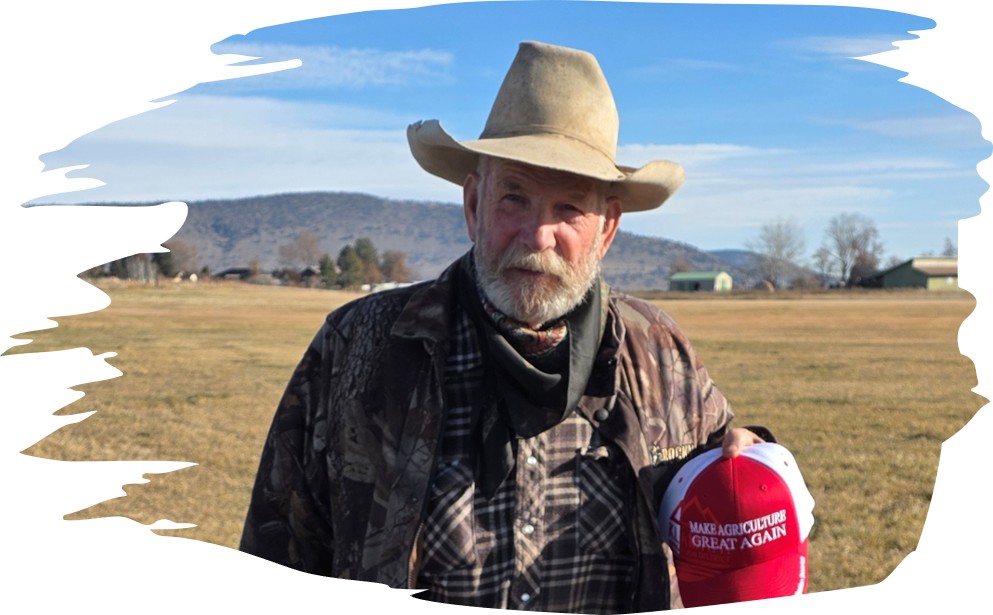
On the Henley-Ankeny lands, the water rights date back to 1884—ironclad claims established well before the federal government ever authorized the Klamath Project. Yet, for David Archibald, the true measure of a rancher isn’t just the date on a paper decree; it’s the ability to survive when the world dries up around you.
David’s story is a testament to the grit required to farm in the modern West. It is a story of going broke, refusing to break, and finding a home in the Klamath Basin—a home he now believes is under siege by well-meaning but destructive Endangered Species Act (ESA) policies.
The Long Road to the Basin
David didn’t start on these specific acres. His journey began in 1972, running cattle across the rugged landscapes of Butte, Yuba, Siskiyou, Placer, and Eldorado counties. He knew the rhythm of the land and the diversity of the harvest, growing everything from alfalfa and oats to wheat, safflower, and rice, watered by the Yuba, Butte, and Sutter districts.
But the life of a rancher is never a straight line. In 1986, after two punishing years of drought, David went broke. In an era where many walked away or filed for bankruptcy, David dug his heels in. He refused to file. Instead, he started over the hard way: slowly, piece by piece, buying cows and “good cow dogs” to work rough country that others might have abandoned.
It was the roads that eventually brought him home. For 25 years, David worked on the highways of the region. It was from the cab of a rock truck—running routes from Weed to Dorris, Tulelake to Merrill and Canby—that he fell in love with the Klamath Basin. He realized this wasn’t just a job site; it was a community he belonged to. Though he lives in Dorris today, his roots here run deep; his Great Aunt Pearl lived in the basin for 40 years, a testament to his family’s long-standing connection to this soil and he currently operates a portion of his ranching business on Henley-Ankeny ground within Klamath Irrigation District.
A Habitat Out of Balance
Today, David looks at the Basin and sees a landscape managed by policies that ignore the people living on it. His frustration with the ESA is palpable, paralleled by his experience with the return of wolves to the region.
David recalls the era when wolves reappeared in California and Oregon. To him, the devastation they caused was a clear signal that the species was being prioritized over the habitat’s reality. He views their presence not as a natural return, but as a forced “implantation” into a working landscape that was no longer designed to support them without catastrophic conflict.
For David, the water crisis is the same story written in a different language. Just as he feels the wolf was forced into a habitat it dominates destructively, he sees current water management prioritizing single-species theories over the 1884 water rights that support the local culture. The result is a regulatory drought that threatens to starve the very families who feed the nation.
The Call for Active Hope
Despite the hardships, David’s message is not one of defeat. You don’t rebuild from zero in 1986 without a reserve of hope. He is a true believer that the silence of the rancher is the greatest danger to the Basin.
“Everyone needs to be more involved and active,” David urges. He believes that if the community stands on its senior rights and demands common-sense reform, the resilience of the Klamath farmer will outlast the bureaucracy.
David Archibald is no stranger to rough country or dry years. He has driven the rock trucks, worked the cattle, and paid his debts. Now, standing on the Henley-Ankeny lands, he is asking his neighbors to do the difficult work once more: to show up, speak up, and protect the water that makes their way of life possible.