To acquire, maintain, assure, and deliver an adequate water supply for beneficial use on qualified land within the Klamath Project.
We represent our Patrons before government agencies, the legislature, Congress, and in such forums as appropriate for the perfection and protection of their water rights. We defend the District from actions which would diminish our effectiveness and function. We further promote the conservation of water, soil, and other natural resources.
Endangered Species ActGene Souza2026-08-24T14:47:25-08:00
The District · Reference & Advocacy
Endangered Species Act
Few federal laws shape the Klamath Basin more directly. Two endangered fish in Upper Klamath Lake, a threatened salmon downstream in the tributaries, and endangered whales off the coast that feed on a different salmon sit at the center of how Project water is stored and released each year — and of how the District defends the deliveries its patrons depend on. This is the District’s public reference on the law, the species, the science, and the record.
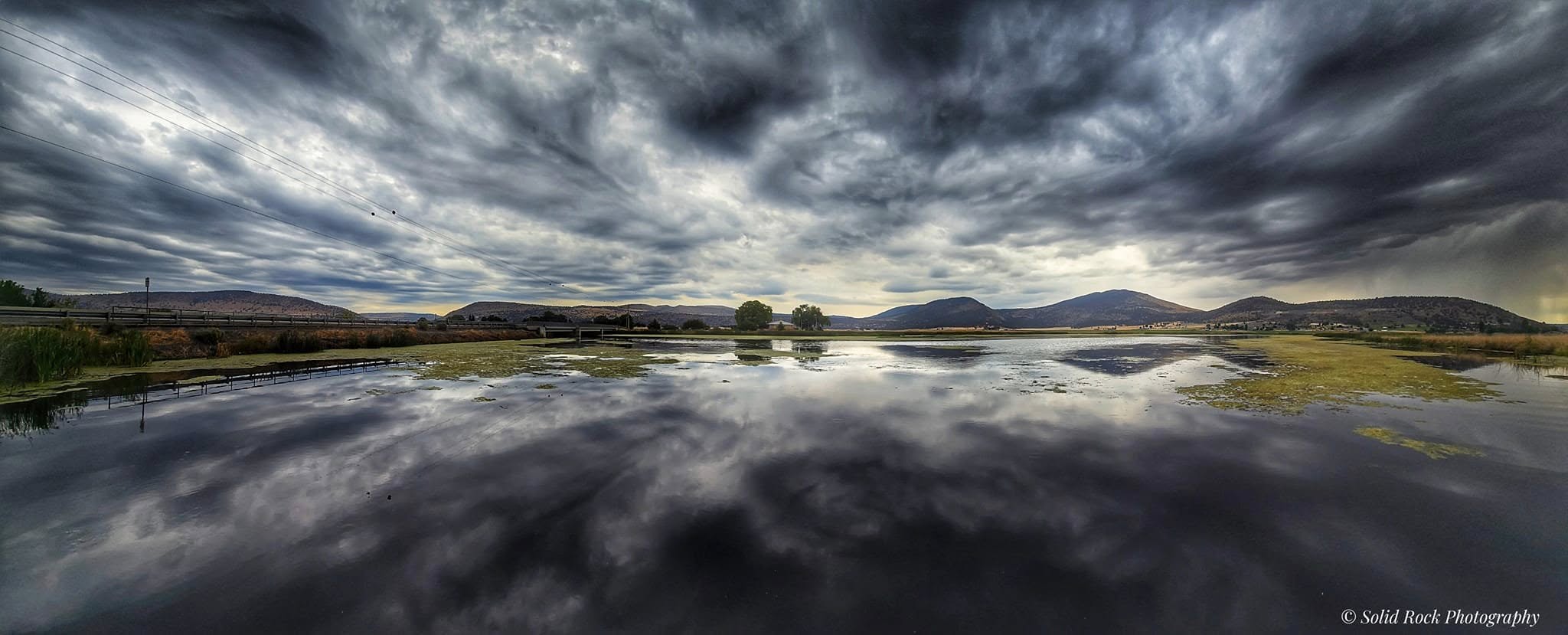
The late-summer Klamath River. Clouds mirrored on the water beneath drifting mats of algae. Photo by Solid Rock Photography.
Start here · The short version
The Klamath Project stores water. Under Oregon’s adjudication, the right to use and deliver that water belongs to the districts and their patrons — it is not Reclamation’s to allocate.
In June 2026 the Ninth Circuit held that the Endangered Species Act applies to Project operations. The District is still pressing the questions the court did not reach.
The District’s argument is not against protecting the listed species — it wants them recovered. It is that a single-species law, run for decades through litigation, is the wrong tool: across those decades the listed fish have kept declining, and the basin is no nearer recovery.
The durable fix is a whole-basin restoration, built together with the Tribes and the District’s neighbors across the basin.
Four ESA-listed species shape how Project water is stored and released — but under Oregon’s adjudication, the right to use and deliver that water belongs to the districts and their patrons, not to Reclamation.
The Endangered Species Act protects species listed as threatened or endangered, along with the habitat they depend on. Its most consequential provision in the Klamath is Section 7, which requires federal agencies to consult with the U.S. Fish and Wildlife Service and NOAA Fisheries to ensure their actions are not likely to jeopardize a listed species or harm its designated critical habitat.
Four listings drive that consultation here. The two endangered suckers — the c’waam and koptu, fish the Klamath Tribes have known and relied on for generations and that Basin families call mullet — were listed in 1988. They are found across the Upper Klamath and Lost River watersheds — not only in Upper Klamath Lake — with self-sustaining populations in Clear Lake and Gerber reservoirs and suspected self-sustaining populations in Tule Lake; a reconnection to Sheepy Creek could establish another at Lower Klamath National Wildlife Refuge. It is the Upper Klamath Lake population whose needs drive the lake-elevation requirements in the Project’s biological opinion.
The SONCC coho salmon — listed threatened in 1997 — depends on the Klamath River below the Project, tying its protection to river flows. A fourth species enters indirectly: the Southern Resident killer whale, listed endangered in 2005, which feeds on Chinook salmon — so the basin’s salmon production is drawn into the consultation through the orca’s prey base.
Within the Project, the Bureau of Reclamation’s role is storage. Because Section 8 of the Reclamation Act ties Reclamation to state water law, the District’s position is that the Klamath Basin Adjudication — Oregon’s Amended and Corrected Findings of Fact and Order of Determination (ACFFOD) — is the controlling legal framework, and under it Reclamation’s only Project water right is a right to store water. It decides how much is held in Upper Klamath Lake for irrigation and the refuges, manages flood releases, and operates the control works, including Link River Dam — but the rights to use and distribute that water are state-adjudicated and belong to the districts and their patrons, not Reclamation’s to allocate.
That same adjudication confirmed the Klamath Tribes’ time-immemorial rights — the most senior in the basin, for Upper Klamath Lake levels and the Tribes’ treaty fishery — to which the District’s own rights are junior. To the District, those senior rights are not a point of dispute but a foundation for cooperation: the Klamath Tribes have at times worked with Basin farmers to ease this conflict, including agreements that have allowed irrigation to continue while the adjudication process runs its course. The District’s position rests on that priority system rather than against it: under the state water law the adjudication settled, the right to use and distribute Project water belongs to those who hold it, in their order of priority, not to Reclamation as a matter of federal discretion.
The operating is done locally: under their 1954 transferred-works contracts, the Klamath and Tulelake Irrigation Districts accepted “the care, operation, and maintenance” of the canals, drains, and pumps that carry and deliver Project water. So what the ESA reaches as “Project operations” is, in the District’s view, Reclamation’s storage and flood-control decisions — not the districts’ running of the works.
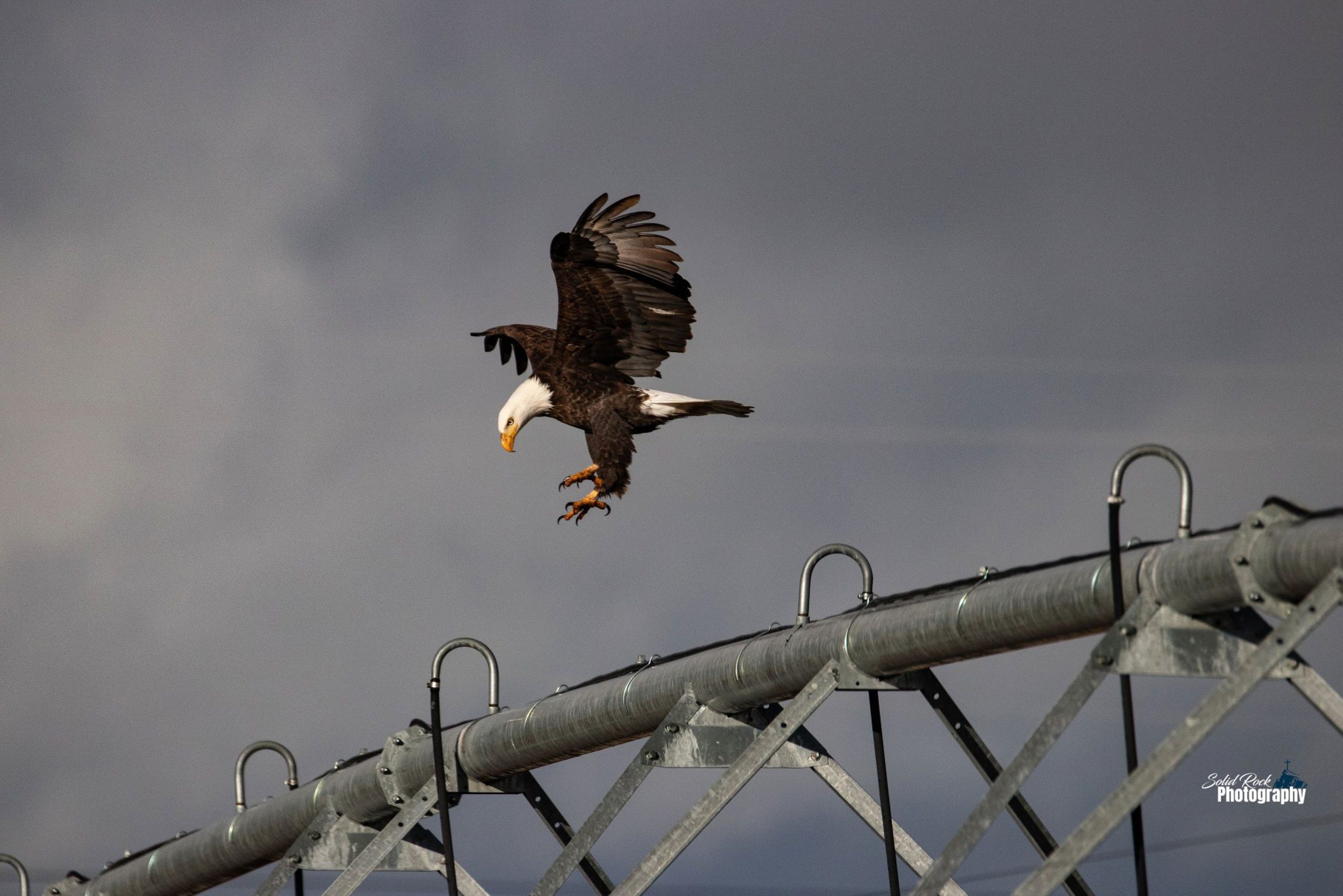
A bald eagle in February. One of many nesting pairs across the Klamath Reclamation Project, settling onto an irrigation pivot to scan for prey — wildlife and the working landscape, on the same water. Photo by Solid Rock Photography.
What was the Endangered Species Act meant to do?
Congress built the Act to protect species and to make agencies cooperate with state and local governments on water disputes — a cooperative duty Klamath management has too often set aside.
The Endangered Species Act was built on more than a federal directive. In its statement of policy, Congress declared that “Federal agencies shall cooperate with State and local agencies to resolve water resource issues in concert with conservation of endangered species” (16 U.S.C. § 1531(c)(2), added by the 1982 amendments), and it directs the Secretary to work with the States “to the maximum extent practicable.” That cooperative duty was written for water disputes much like the Klamath’s — and the District is exactly the kind of body it names: a special government district organized under Oregon’s irrigation-district law, ORS chapter 545, so the duty to cooperate runs directly to local governments like KID.
It sits alongside a strong protective purpose. The Supreme Court has read the 1973 Act as a resolve to halt extinction “whatever the cost,” with Section 7 giving listed species priority over an agency’s other missions — the part of the law the courts most often enforce, including here. The District’s point is not that this protective mandate should be weakened, but that the cooperative half of the Act — written for exactly this kind of water dispute — has too often been displaced by distant, litigation-driven management. Durable recovery in the Klamath, in the District’s view, will come from using it: State, local, and Tribal partners working alongside federal agencies on solutions grounded where the consequences are felt.
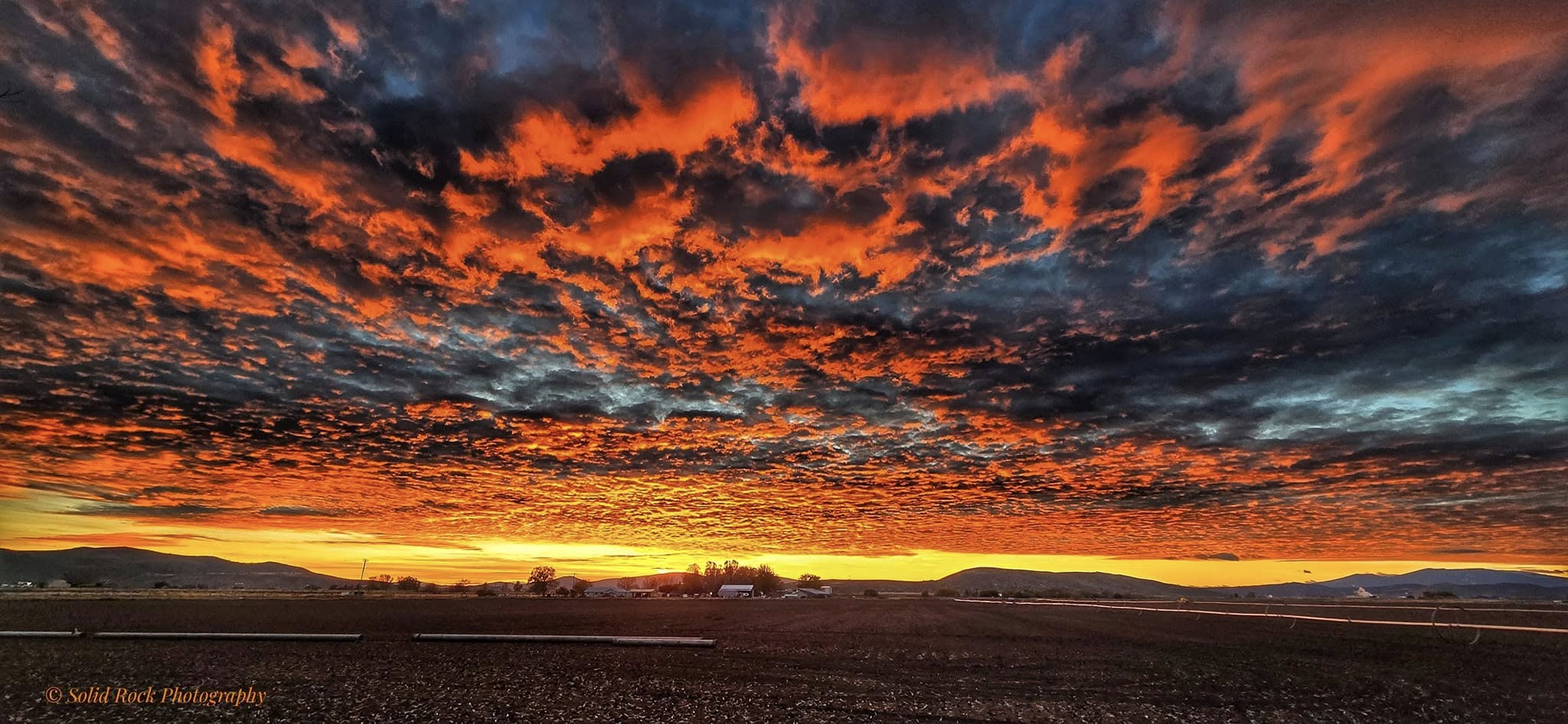
Sunrise over the Klamath Irrigation District. Deep gold reflected on a dark, clouded sky. Photo by Solid Rock Photography.
Watch · KID Symposium
ESA at 50 Symposium
Hosted by the District at Klamath Community College on March 11, 2024 — 16 recorded talks on the Act’s first half-century and what it means for the basin.
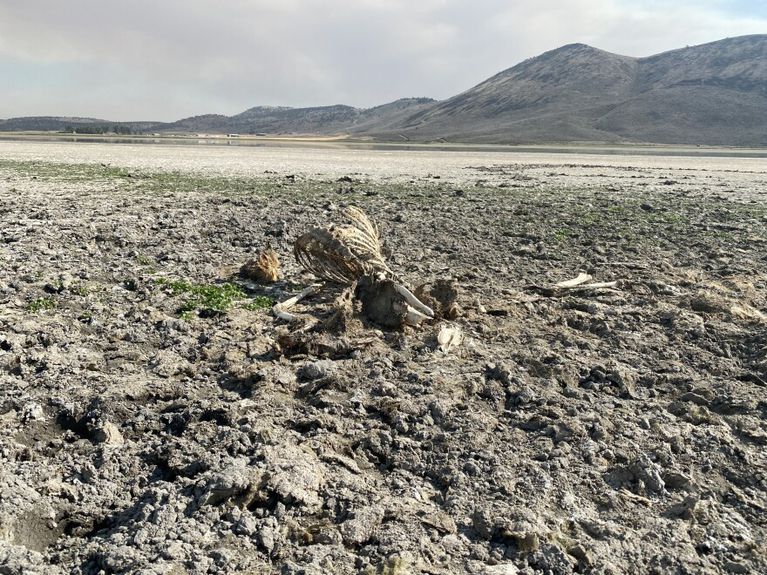
Spring Lake, dry in 2021. The skeletal remains of a cow on what was natural marshland — the whole-system stakes a single-species process never weighs.
What governs Project operations today?
Two 2024 Biological Opinions govern how the Project stores and releases water, with the river-flow compliance point now at Keno Dam since Iron Gate Dam was removed.
Reclamation’s decisions on storing and releasing Project water are governed by two 2024 Biological Opinions — one from the U.S. Fish and Wildlife Service covering the c’waam and koptu (effective through October 2029) and one from NOAA Fisheries covering coho salmon and the Southern Resident killer whale (through September 2029). With Iron Gate Dam removed in 2024 as part of the lower-river dam removal, the compliance point for river flows moved upstream to Keno Dam.
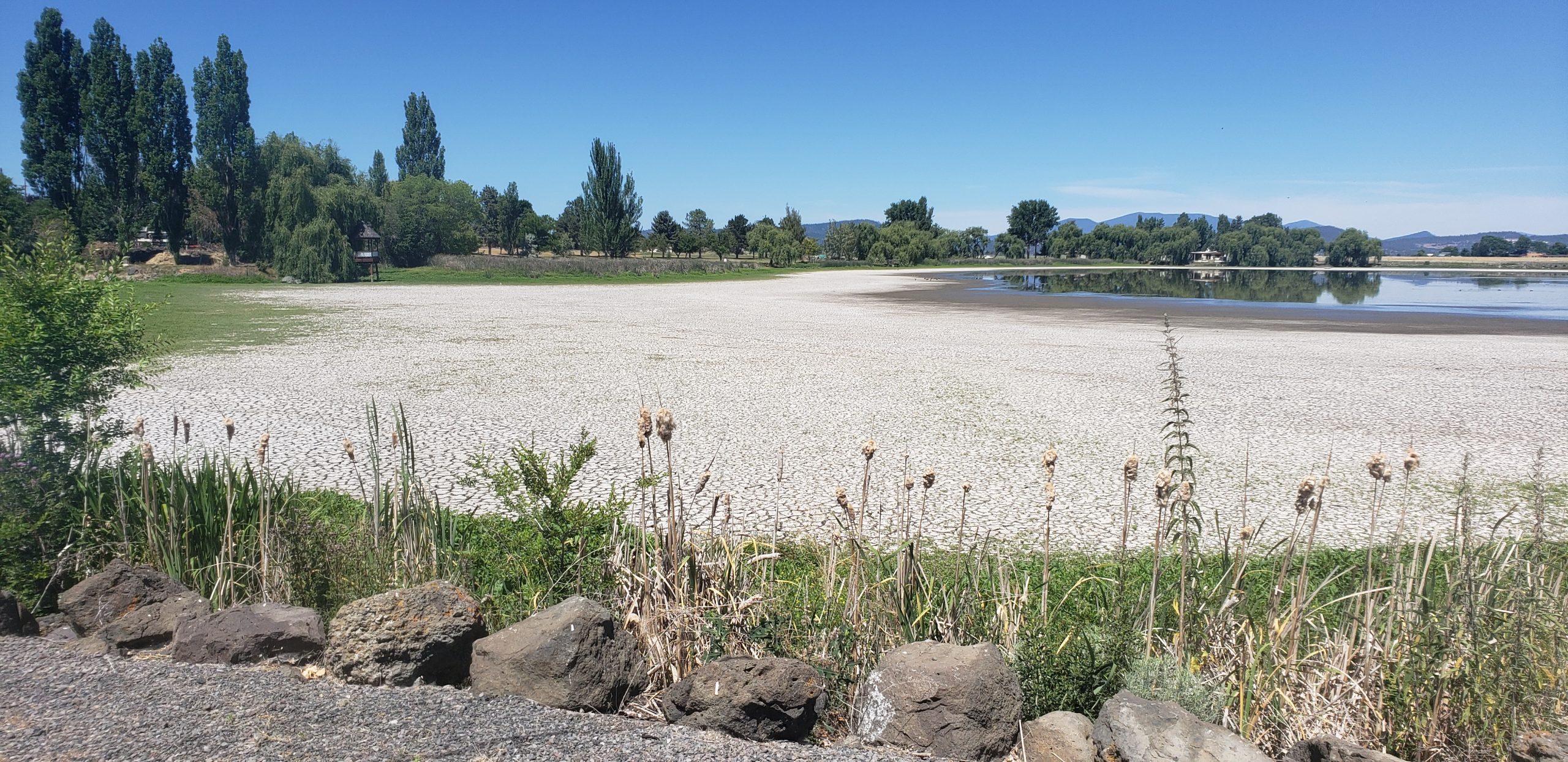
Tingley Lake going dry in 2020. A season with no inflow once the irrigation water was shut off — what the basin loses when delivery stops.
Interactive · Section 7
The ESA dashboard
An interactive walk through Section 7 for the Klamath — the nine rules, the water budget, and the District’s analysis.
We’re building this out page by page. Each opens into a deeper look at one part of the Klamath ESA story.
In development
The law in the Klamath
How Section 7 consultation works, what “take” and “jeopardy” mean, and where Habitat Conservation Plans fit.
In development
The Biological Opinions
What the 2024 BiOps require of the Project — the lake elevations, the river flows, and the operations behind them.
In development
The record & litigation
The District’s documented position, the key opinions and memoranda, and the cases shaping Klamath water.
Primary sources & references
The statutes, regulations, species records, and Project Biological Opinions behind the pages above. As each sub-page is built, these move to where they fit best.
▸ Show all sources
By the numbers — the operative ESA sections, and the Reclamation Act mandate behind Project water