
Feature Story · West Coast
Inbreeding Contributes to Decline of Endangered Killer Whales
New genome sequencing shows Southern Residents are highly inbred. Southern Resident Connections — Post 30.
March 20, 2023
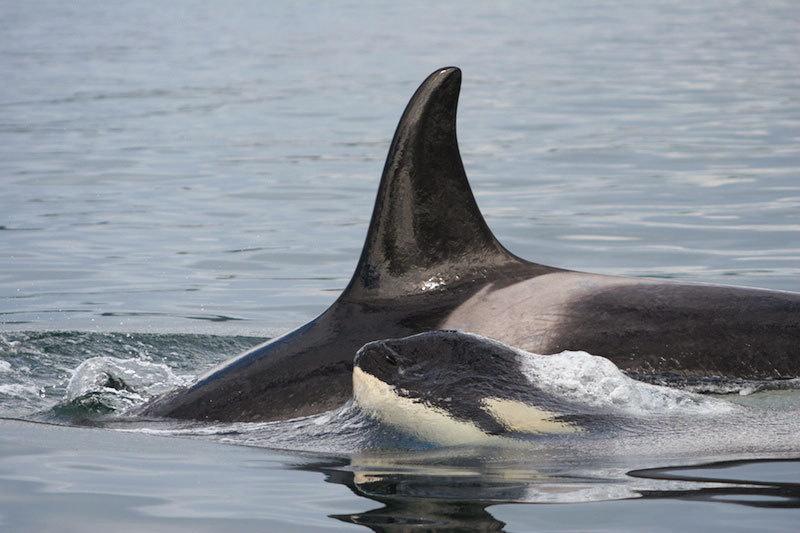
The small size and isolation of the endangered Southern Resident killer whale population in the Pacific Northwest have driven high levels of inbreeding. That inbreeding has contributed to a decline that has continued even as neighboring killer whale populations expand, according to research published in Nature Ecology and Evolution.
The study paired modern genomics with decades of careful field observation. An international research team used it to fill a major gap in understanding why the Southern Resident population has failed to thrive.
Newly sequenced genomes from the 73-whale population indicate that inbreeding is an important problem, alongside human impacts such as marine-park captures decades ago. Other well-recognized contributors to the decline include disturbance, contaminants, and possible prey limitations.
By lowering survival, inbreeding can cut a whale's lifespan nearly in half. Absent an influx of genetic diversity from other populations or some other major improvement in conditions, the decline is likely to continue.

The researchers concluded that inbreeding depression can substantially limit the recovery of endangered populations. Marty Kardos, a research geneticist at NOAA Fisheries' Northwest Fisheries Science Center and a lead author, described the findings as “hard news for everyone who cares about this unique population,” while noting they help answer long-standing questions about why recovery efforts have not produced hoped-for results.
Southern Resident Genome Sequenced
The work includes the first major findings from sequencing of the Southern Resident genome, which began in 2018 in collaboration with the genomics company BGI and The Nature Conservancy. The project has decoded the DNA of roughly 100 Southern Resident killer whales, including some that died in recent years, and also examined whales from other populations in the northeast Pacific.
Eric Ward, a statistician at the science center and co-author, said the research helps explain why this population has consistently lower survival and birth rates than other regional killer whales, pointing to a strong link between inbred individuals and increased risk of death — a view not previously available.
Addressing Known Threats
Historically, researchers have concentrated on three main threats to the Southern Residents: fluctuations in salmon prey; toxic pollutants; and disturbance and noise from ships and other vessels. NOAA Fisheries' 2008 Recovery Plan named inbreeding as a concern, but only recently has the technology existed to measure its population-level effects.
The new research indicates that inbreeding strongly limits population growth and recovery and makes the whales more vulnerable to the other threats. According to Brad Hanson, a research scientist at the Northwest Fisheries Science Center who leads field research on the whales, that underscores the urgency of addressing those other threats — for example, by restoring salmon habitat. “The whales are not necessarily dying of inbreeding itself,” he noted; rather, inbreeding leaves them more vulnerable to disease and other problems, so they die prematurely.
Inbreeding Reduces Life Span
Killer whales first reproduce at about 10 years old and reach their reproductive prime in their early twenties. The analysis found that highly inbred Southern Residents had less than half the chance of surviving those prime years to reach 40, compared with the least-inbred individuals. Females with low inbreeding live long enough to produce an average of 2.6 offspring over their lifetimes, while highly inbred females average 1.6. A population must produce at least two surviving offspring per female to remain stable or grow.
Wildlife managers often address inbreeding in small populations through captive breeding or by introducing animals from other areas to add genetic diversity. That approach is unlikely to help the Southern Residents, which reproduce only within their own population even though they encounter other killer whales in their home waters.
In the 1960s and 1970s, marine parks removed about 50 resident killer whales from the Salish Sea, and others died during the captures; most were Southern Residents. That reduced the genetic diversity of an already isolated population and may have placed it at a competitive disadvantage as other fish-eating killer whale populations in the northeast Pacific tripled, increasing competition for salmon.
Few Whales Dominate
Earlier genetic research led by senior scientist Michael Ford of the Northwest Fisheries Science Center, a co-author of the current study, showed that Southern Residents often mate within their family groups. The 2018 analysis found that two males had fathered more than half of the sampled calves born since 1990. That dominance by a few whales prevents the genetic mixing that could otherwise help the population avoid inbreeding and adapt to environmental change.
Only about 26 of the 76 endangered whales were breeding at the time. Reducing the effective size of the population increased the potential for inbreeding and compromised individual survival — reduced survival that has contributed to a lack of consistent growth, including a decline from a peak of nearly 100 whales in the mid-1990s to 73 at the time of the study.
Using models based on the average environmental conditions of recent decades, the team found that when all whales were assigned the survival probability of the least-inbred animals, the population increased; when the population's actual, inbreeding-affected survival odds were applied, it declined. Ward cautioned against over-attribution: “It would be a mistake to see this as inbreeding alone causing the decline.” He noted the population has faced multiple stressors over 50 years whose relative impact has shifted over time, and that the mating system — with only a few males contributing to the gene pool — may have made inbreeding a more significant threat in recent years.
Southern Resident Connections
Southern Resident killer whales are icons of a vibrant but struggling marine ecosystem that matters to us all. NOAA Fisheries' series explores the ecological connections that tie this system together and the work underway to protect and recover the whales.
More Information
- Kardos et al. 2023 — Inbreeding depression explains killer whale population dynamics (Nature Ecology & Evolution)
- Saving the Southern Residents (story map)
- Southern Resident Connections
- Inbreeding and Inbreeding Depression in Southern Resident Killer Whales
- Southern Resident Killer Whale Research in the Pacific Northwest
- Killer Whale Genetics Raise Inbreeding Questions (earlier feature)
Primary source citation: Kardos, M., Zhang, Y., Parsons, K.M., Yunga A, Kang, H., Xu, X., Liu, X., Matkin, C.O., Zhang, P., Ward, E.J., Hanson, M.B., Emmons, C., Ford, M.J., Fan, G., & Li, S. (2023). Inbreeding depression explains killer whale population dynamics. Nature Ecology & Evolution, 7(5), 675–686. DOI: 10.1038/s41559-023-01995-0. PMID: 36941343.
Klamath Irrigation District — Assessment
What this source establishes, and how KID reads it
The points below distinguish what NOAA reports from KID's own inferences, which are labeled as inferences.
What NOAA and the peer-reviewed study report (observed / modeled)
| Point | Basis |
|---|---|
| Inbreeding depression strongly limits Southern Resident survival and population growth. | Modeled and genomic — Kardos et al. 2023. |
| Highly inbred females average 1.6 lifetime offspring vs. 2.6 for the least inbred; at least 2 are needed for stability. | Observed / demographic estimate. |
| The whales breed only within their own closed population, and two males fathered more than half of sampled calves since 1990. | Observed (genetic parentage). |
| Captive breeding or introducing outside animals is unlikely to help, because the whales will not outbreed. | Stated conclusion, NOAA / study. |
| Models grow the population under least-inbred survival, but decline it under actual survival odds. | Modeled projection. |
KID's inference (labeled as inference)
KID infers that these findings identify a substantial, intrinsic constraint on Southern Resident recovery — reduced survival driven by the population's genetics and closed mating system — that is independent of, and not remedied by, changes in prey availability alone. In KID's view, this bears directly on claims that link Klamath Basin flow or salmon-prey measures to Southern Resident recovery: a recovery ceiling set by inbreeding depression and a closed gene pool would not be lifted by prey-directed actions, however those actions are otherwise justified. KID presents this as an inference drawn from the cited record, not as a claim made by NOAA.