
How the Board Is Elected & Governed
Governance under ORS Chapter 545 & the District Bylaws
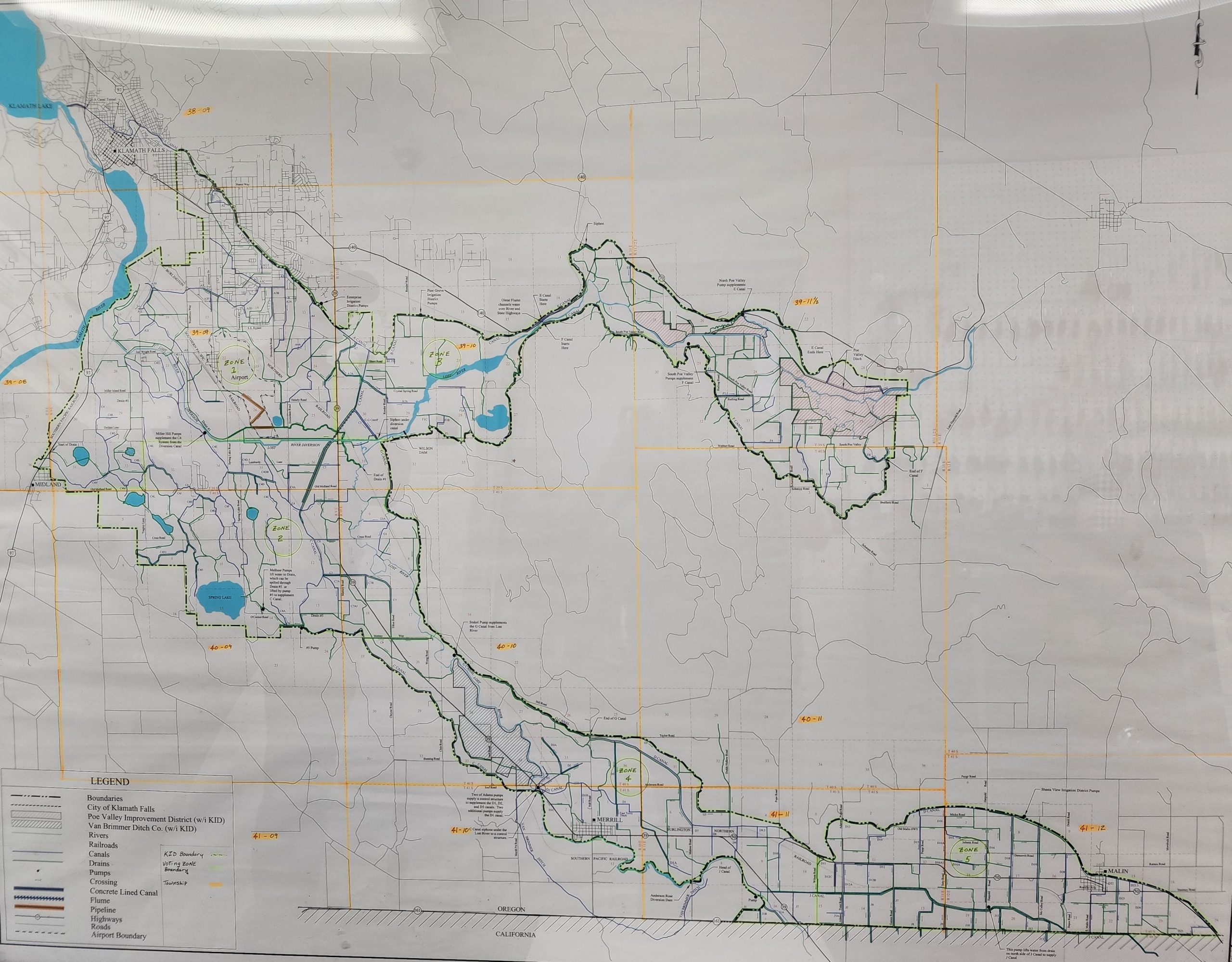
Klamath Irrigation District is a municipal corporation governed under Oregon's Irrigation District Law (ORS Chapter 545) and its own adopted Bylaws. The District is divided into five divisions, and it is governed by a five-member Board of Directors — one director elected from each division — who set policy, adopt the budget, and direct the District's operations. Here is how those seats are filled and how the Board is organized.
Who can serve
Every director must be a resident of Oregon and a bona fide owner of land within the division they represent — or an authorized shareholder of a corporation that owns such land. A director who later moves out of state, or who no longer owns qualifying land in the division, automatically leaves the seat, which is then filled as a vacancy.
How directors are elected
Directors are chosen by the voters of their own division, not by the District as a whole. The District holds an election on the second Tuesday of November each year, with one or more seats on the ballot. Each term runs three years, and the terms are staggered so that no more than two seats come up in any single year. The candidate with the most votes wins and takes office at the Board's annual organizational meeting the following January, serving until a successor is elected and qualified.
How candidates get on the ballot
Any District member who wishes to run for a seat may be nominated for the office of director. The District provides nomination petitions and other appropriate assistance to prospective candidates, though District employees do not give legal advice. The election itself is conducted under ORS 545.135 to 545.153.
Who votes, and how votes are weighted
An elector is any person 18 or older who owns — or is buying under a recorded contract — land within the District that is subject to its charges. Voting rights run with that land ownership rather than with general residency, and proxy voting is not allowed. Each ownership casts a single bloc of votes based on the acreage it holds. Land owned jointly, or by a company, votes as one owner through an authorized representative, and when the District votes by division for that division's director, only the qualified voters of that division take part.
- Up to 40 acres → 1 vote
- 40 to 160 acres → 2 votes
- More than 160 acres → 3 votes
How a vacancy is filled
If a seat opens mid-term for any reason, the remaining directors appoint a qualified person from the same division to hold the seat temporarily. The division's voters then elect a permanent successor at the next District election, and that successor finishes the remainder of the original three-year term.
The Board's officers
Each January, at its annual organizational meeting, the Board elects its officers to one-year terms: a President, a Vice-President, and a Secretary. The President and Vice-President must be sitting directors. The President presides over meetings and signs District documents, the Vice-President steps in when the President is absent, and the Secretary keeps the official records, conducts District elections, and oversees the District's funds, charges, and assessments — an office described in more detail below.
How the District is run day to day
Day to day, the District is run by a full-time District Manager — the “Manager” described in the Bylaws — who oversees operations, supervises staff, prepares the budget for the Board, and carries out Board policy. The Board itself meets in regular monthly public meetings, with its annual organizational meeting held the first Tuesday of January. A majority of directors is a quorum, and it takes the affirmative vote of three directors to approve any action. All meetings are open to the public under Oregon's Public Meeting Law, except for closed sessions allowed by law.
The Secretary
The Secretary is a standing official office of the Board, kept separate from any one staff job. By resolution, the Board may appoint as its Secretary an elected director, the District Manager, or the Executive Director. At KID, the Board currently has the Executive Director serve as the Secretary.
When the District is not in constant conflict — and does not need sustained advocacy in Washington, D.C., Salem, Sacramento, and other lobbying forums — the District Manager can effectively manage the District and carry the secretarial duties as well, and no Executive Director is needed. That is not the situation today, so the Board has filled the Executive Director position. The District is working hard to build the stability that would let this position be eliminated in the near future.
The Executive Director is a separate, optional position the Board fills only when the District needs a full-time advocate in local, state, and federal affairs beyond what the Board itself can cover. It is defined not in state law or the Bylaws but in the District's adopted Accounting & Financial Policy. The Executive Director helps the Board shape and carry out a long-term strategic vision; the position is not required for the District's day-to-day operations and maintenance, and it is left unfilled when a full-time outside advocate is not needed.
Reference & Sources
The law, documents & tools behind the District
The state and federal law behind KID's water rights, and the board, elections, budget, and records that govern the District and keep it accountable to its patrons.
Water rights & legal framework — the authority KID operates under
District governance & accountability — how KID is run, and how patrons take part
This page is provided for public information and paraphrases the governing law; the controlling authority is the Oregon Revised Statutes, Chapter 545 (Irrigation Districts), and the District's adopted Bylaws. Read the full District Bylaws (PDF) or the full statutory text at oregonlegislature.gov.