
From the History File
The Warren Act of 1911
Two different things are called “priority.” The State of Oregon has already ruled on which one governs.
It is a fair question to ask the District: if Warren Act contractors hold junior priority, why do they receive water in a drought year? The instinct behind the question is right — there is a hierarchy, and Warren Act contracts really are subordinate in a short year. But it is not a water right priority date, and this is not a matter of opinion. Claimants tried to turn their Warren Act contracts into water rights in the Klamath Basin Adjudication. The State of Oregon denied those claims and explained why.
The question
Curious why Warren Act contractors get water when senior contractors are not guaranteed deliveries to the end of their water right date?
Bottom line
Warren Act contractors are not junior in the State of Oregon's records. Claimants argued the opposite of that in the adjudication — that their Warren Act contracts carried water rights of their own — and the State denied those claims and placed the lands inside the Project claim on the Project's own 1905 priority.
They are subordinate under their contracts, which is a different thing, decided by different documents. But subordinate is not the same as unquantified. Each of those contracts states what the contractor is to receive, and some provide for apportionment of the available surplus when there is not enough. A per-acre limit set in an annual operations plan is a third thing again, and it is not what the parties signed.
Contracts govern delivery. The adjudication governs the right. Keeping the two apart is most of what it takes to follow water in this Basin.
Every statement on this page is sourced where it appears, and the documents are listed in full at the foot of the page.
What the State of Oregon determined
The Klamath Basin Adjudication is where water rights in this Basin were settled. Its Corrected Partial Order of Determination for OAH Case 003 disposed of the Klamath Project claims, and it addressed the Warren Act contracts head-on.
The order holds that the Warren Act contracts did not separately convey any additional rights to the contractors. Those contracts were entered into under 43 U.S.C. §§ 523–525, by which the United States promised to deliver water in return for a payment and annual fees. Nothing in them transfers a right. The order points to the contracts' own recital: the contractor proposes to irrigate the described acres by utilizing Klamath Project water rights.
So the portions of those claims founded on Warren Act contracts were denied. The lands themselves were not left out in the cold, however. They are entitled to a water right based on the United States' Notice of Appropriation of May 19, 1905, and where they fell within the Project claim they were recognized as part of the place of use for the consolidated Project claim.
The order states the principle plainly: a contractual system for determining how water is divided among multiple users within a place of use has no bearing on the adjudication of the appropriate priority date for that place of use. Priority dates are established according to state law.
Corrected Partial Order of Determination, OAH Case 003, Effect of BOR Contracts, para. 21.
That is the answer to the question, from the only body with authority to give it. Warren Act lands sit inside the Project claim on the Project's priority date. Their contracts govern delivery, not priority.
The order also settles who holds what: Reclamation's right is a right to store, and the right of beneficial use is held by the beneficial users. That determination, and the storage figures behind it, are set out on the Water Rights and Contracts page.
But storage is all it is. The order holds that the right of beneficial use of water in the Project is held by the beneficial users, and says so of live flow and stored water alike. The users' claim to appropriate water actively stored in Upper Klamath Lake was recognized inside the Project consolidated claim. Reclamation stores; the users hold the right to use. Those are different things, and the order keeps them apart.
The three claims, as determined
Three adjudicated claims govern the District's operations — KA-1001 (Van Brimmer, 1883), KA-1004 (Ankeny-Henley, 1884) and KA-1000 (the Klamath Project, 1905) — and their priority dates, rates, duties, seasons, diversion caps and ownership are set out on the District's Water Rights and Contracts page.
What matters here is that every Warren Act land in the Project is served under KA-1000, on that 1905 priority date, alongside everyone else. There is no separate, later-dated Warren Act right, because the State declined to create one.
What the District agreed to carry
In 1954 the District signed the transferred-works contract with the United States and, on January 1, 1955, took over care, operation and maintenance of the Project's canals, drains and pumps. (The history pages carry the longer account of how the Project was built and how the District came to operate it.) It also took on the United States' delivery obligations to others. Those obligations are spread across several articles.
Article 13(b)
The Warren Act contractors
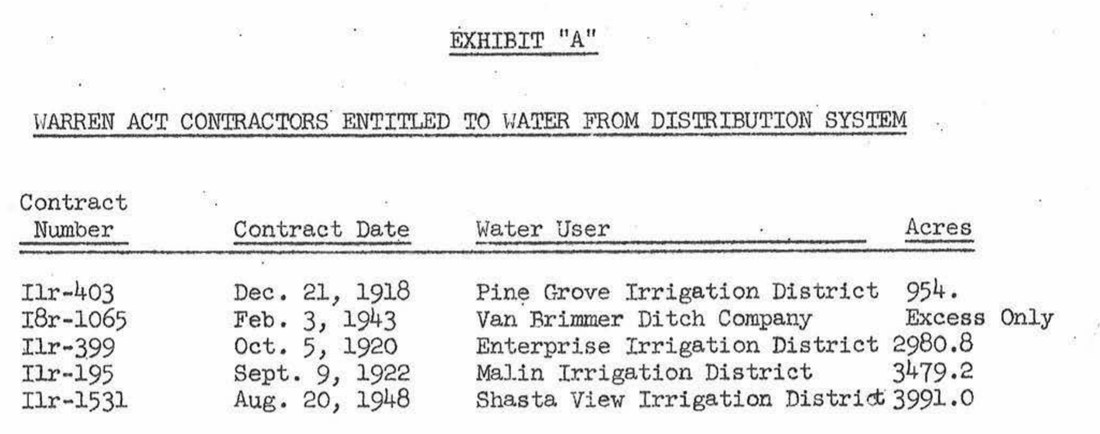
The District assumed and agreed to carry out all obligations imposed on the United States by the contracts listed in Exhibit “A,” headed Warren Act Contractors Entitled to Water from Distribution System, so far as they concern carriage and delivery through the transferred works.
Van Brimmer is on that exhibit for one thing only: water above the fifty second-feet settled in 1909. Its entry is recorded not in acres, like every other line, but with two words — Excess Only. The settled fifty is not a Warren Act delivery and is carried under Article 13(a).
110 entries under 100 contract numbers, dated 1918 to 1948. Six are districts or companies — Pine Grove, Enterprise, Malin, Sunnyside, Shasta View, and the Van Brimmer Ditch Company for its excess. The other 104 are individual landowners.
Article 13(c)
Contracts that came later
Where the United States executes a future contract for carriage and delivery through the transferred works — serving Pumping Division lands, or individual users outside the District reachable through those works — the District assumes the obligation as if the contract had existed in 1954. No such contract may require enlarging the works unless the United States or the contractors pay for it.
This is how the Klamath Basin Improvement District came in, in 1962. See Article 13(c), in practice.
Article 26 adds what everyone in this Basin already knows: on account of drought or other causes a shortage may occur, the United States will use all reasonable means to guard against it, and no liability accrues against the United States for the damage when it comes.
Contract No. 14-06-200-3784, November 29, 1954, Articles 13, 14, 15, 19 and 26, and Exhibits “A” and “C.”That sentence has an affirmative half as well as a disclaimer, and the District's reading of what “all reasonable means to guard against it” requires — of storage, and of what the United States proposes in Endangered Species Act consultation — is set out on the Water Rights and Contracts page.
Where the delivery order is written
The adjudication settled priority. The contracts settled the order of delivery, and three of them say it outright.
Tulelake's 1956 contract states that the District's rights are equal to those of others contracting under the Reclamation Act of 1902, and prior to rights conferred under contracts executed under the Warren Act. It adds that where a shortage arises from drought or other unavoidable causes, the United States may apportion the available supply among those holding rights of priority equal to Tulelake's.
That second sentence needs care, because it is easy to read as though it settled something for everyone. It did not. It is a term of Tulelake's contract, and it binds the parties to Tulelake's contract. This District's 1954 contract contains no apportionment provision at all. The words allocation and apportionment appear in it only in relation to money — the general expense apportioned between the Main and Pumping Divisions under Article 16, and the reserved-works costs allocated between the District and other agencies. Nothing in the District's contract provides for apportioning water, and the District agreed to no such term.
Contract No. 14-06-200-5954, September 10, 1956, Article 33(b) and 33(c).Van Brimmer's contracts show the same ordering from the other side, and they are worth separating carefully, because the Company holds two different things under two different kinds of instrument.
The contract of November 6, 1909 is a settlement agreement, not a Warren Act contract. The Project was going to lower Lower Klamath Lake and, in the contract's own words, would in all probability destroy or impair the Company's source of supply at its own diversion point. The Company waived and renounced its riparian claims to the United States; the United States undertook to deliver fifty second-feet from the Project in their place. That fifty second-feet is settled entitlement, and the State later adjudicated it as the Company's own right with an 1883 priority.
Water above the fifty second-feet is a different arrangement, and a different piece of plumbing. The settled fifty comes from Upper Klamath Lake and reaches the Company by gravity through the Project canals; the Lost River cannot deliver to those lands by gravity at all. Water above that figure would be pumped from the Lost River — into which the District spills — on terms that behave like a Warren Act contract. Under the amendatory contract of February 3, 1943, such water is paid for by the acre-foot, and the United States is not obligated to deliver any of it when the excess is needed for the Project lands or for the Warren Act contractors, whether those contracts predate or postdate 1943.
In practice that provision is dormant. The District does not typically deliver above fifty second-feet, and does not anticipate doing so in the foreseeable future. What the Company receives is the settled entitlement, delivered as it has been delivered since 1955.
Which explains the entry that looks odd at first glance. The District's 1954 Exhibit “A” is headed Warren Act Contractors Entitled to Water from Distribution System, and Van Brimmer is on it — recorded not in acres, like every other entry, but with two words: Excess Only. The Company is on that sheet for its excess and for nothing else. The settled fifty second-feet was never a Warren Act matter: it is the Company's own adjudicated 1883 right, served under Article 13(a) as water delivered to a user entitled to it. Only the excess sits under Article 13(b).
The District's own Article 19 puts rental water below everyone.
What each contract actually promises
This is where the difference between a right and a contract stops being abstract. The two Reclamation Act contracts name no quantity at all. The Warren Act contracts name one — and define what kind of water it is.
| Contractor | Contract | What the delivery clause provides |
|---|---|---|
| Klamath Irrigation District | 14-06-200-3784, November 29, 1954, Article 13(a) | No quantity stated. The District takes its supply at the headworks and distributes it to the water users entitled to it. |
| Tulelake Irrigation District | 14-06-200-5954, September 10, 1956, Article 33(a) | No quantity stated. All water needed for beneficial irrigation use within the District, subject only to capacity and reasonable beneficial use. |
| Enterprise Irrigation District | Ilr-399, October 5, 1920 | Two acre-feet per acre of irrigable land during the usual irrigation season, approximately May 1 to September 30. |
| Pine Grove Irrigation District | Ilr-403, December 21, 1918, Article 6, as amended June 19, 1936 | Originally a maximum of two acre-feet for each acre of irrigable land. The supplemental contract of 1936 raised that maximum to two and one-half acre-feet. |
| Sunnyside, Malin and Shasta View Irrigation Districts | Ilr-174, Ilr-195 and Ilr-181, 1922 | Not to exceed two acre-feet per acre of irrigable land, April 15 to September 30, and in no event more than six-tenths of an acre-foot per irrigable acre in any one month. |
| Poe Valley Improvement District | 14-06-201-174, July 20, 1953, Articles 1 and 3 | No quantity at all. Water from the Lost River, in variable and indefinite quantities, when and to the extent it is available — and only what may be beneficially used. The District installs its own pumps along the reach below Harpold Dam. |
| Klamath Basin Improvement District | 14-06-200-41-A, April 25, 1962, Part A, Article 2(a) | Each year, surplus water in such quantities as can be beneficially used for irrigation of lands within the District, but not to exceed an average of three and six-tenths acre-feet per irrigable acre. |
| Van Brimmer Ditch Company | Settlement of 1909, Article 2, as amended February 3, 1943 | Not to exceed fifty second-feet, in settlement of the riparian claims the Company gave up — a season of use of April 15 to October 15 as adjudicated. Water above that would be paid for by the acre-foot and is not owed at all when the Project lands or the Warren Act contractors need it — a provision the District does not presently operate under. |
The Klamath Basin Improvement District contract is the one worth reading twice, because the article above it defines the term the promise turns on.
“Surplus water” shall mean water available from the Klamath Project in excess of that required to meet the prior rights of lands and entrymen under the Klamath Project.
Contract No. 14-06-200-41-A, April 25, 1962, Article 1(j).
So the 3.6 acre-feet is not a duty and not an entitlement. It is a ceiling on water that has already been defined as whatever is left after the prior rights of the Project's lands and entrymen are met. The transmittal that accompanied the contract says the same thing in the plainest possible terms: the supply is limited to what is surplus to the needs of the existing Klamath Project, and it is made available under the Act of February 21, 1911 — the Warren Act. The largest figure in the Project's contracts is also the most conditional one, and the condition is written into the definitions.
That phrase — the prior rights of lands and entrymen under the Klamath Project — is the Warren Act's own reservation, carried word for word out of the 1911 statute and into a contract signed fifty-one years later.
And the contractors' own contracts say it too
The subordination does not have to be inferred from Tulelake's contract, or from the District's, or from anyone else's. It is written into the Warren Act contracts themselves, in the contractors' own instruments.
The Shasta View and Malin contracts of 1922 provide that the rights to the use and delivery of water acquired by the District under the contract are inferior and subject to prior rights reserved for the lands of the Klamath Project. Poe Valley's 1953 contract puts it as an affirmative reservation at Article 2: the United States reserves a first right to the lands and entrymen on the Klamath Project of the water to be made available to the District. And the Klamath Basin Improvement District contract of 1962 does it by definition, in the passage above.
Contract Ilr-181, October 6, 1922; Contract Ilr-195, September 9, 1922; Contract No. 14-06-201-174, July 20, 1953, Article 2; Contract No. 14-06-200-41-A, April 25, 1962, Article 1(j).Four decades apart, three different drafters, the same reservation. It is the Warren Act's phrase in each case — the first right of the lands and entrymen already under the Project — and every contractor signed it.
The same contract also says what happens when the surplus runs short. Article 4 provides that on account of drought, inaccuracy in distribution, or other cause there may be a shortage, that no liability accrues against the United States for it, and that in any year in which a shortage occurs from any cause, the United States reserves the right to apportion the available surplus water supply among the District and others entitled, under existing and future Warren Act contracts, to receive water from the Klamath Project. Apportionment among the Warren Act contractors — not among all Project lands, and not ahead of them.
Contract No. 14-06-200-41-A, April 25, 1962, Article 4.Pine Grove is the only one of these that changed. Every district contract on the list began at two acre-feet; Pine Grove asked for more and got it in 1936, which is why a single district sits half an acre-foot above the rest.
Article 13(c), in practice
The Klamath Basin Improvement District contract is also the clearest surviving demonstration of how Article 13(c) actually operates, because the 1962 file shows the whole machine assembled at once.
The contract's recitals state the problem plainly: delivery of surplus Project water to the District's lands depended on enlarging and extending certain Klamath Project facilities — facilities now operated and maintained by the Klamath Irrigation District under Contract No. 14-06-200-3784 of November 29, 1954, which the KBID contract refers to throughout as the Operations Contract. The District's 1954 contract is named in it, by number and by date, as the instrument the whole arrangement rests on.
From there the sequencing follows Article 13(c) exactly. No federal funds could be advanced until two things had happened: a contract between Klamath Basin Improvement District and Klamath Irrigation District under which the latter agreed to care for, operate and maintain the Project Works and to deliver the water; and a contract between Klamath Irrigation District and the United States amending the Operations Contract to permit the construction and provide for the care, operation and maintenance of the works. Three contracts, executed together in April 1962: the United States with KBID, the United States with this District, and this District with KBID.
Note what that arrangement respects. Article 13(c) permits future carriage-and-delivery contracts, but bars any that would require additions to or enlargements of the transferred works unless the United States or the contractors bear the expense. Here the contractor did — Klamath Basin Improvement District borrowed for the enlargement under the Small Reclamation Projects Act of 1956 and repays it. The proviso in the District's 1954 contract was not waived. It was satisfied.
Contract No. 14-06-200-41-A, April 25, 1962, Explanatory Recitals and Article 10(a); Contract No. 14-06-200-3784, Article 13(c).And what it built
The third of those contracts was executed. On April 25, 1962, Klamath Basin Improvement District and Klamath Irrigation District signed an agreement under which this District would operate and maintain the Extensions and carry out the administrative functions of the new district. The arrangement was a close one. Klamath Basin Improvement District had become a legal entity on July 18, 1961, on articles of incorporation signed by 464 landowners, and by 1963 its secretary-treasurer kept his office at the K.I.D. office. It had also executed individual water service contracts with Pine Grove, Enterprise, Shasta View and Malin, each of which had Klamath Basin Improvement District lands inside its boundaries.
What the loan built was dedicated on August 9, 1963, at a ceremony this District co-sponsored: the Stukel, North Poe Valley and South Poe Valley Pumping Plants, enlargement of the Miller Hill Pumping Plant and of portions of the existing D, F and G Canals, and extensions to some drains. The Commissioner of Reclamation and the congressman for Oregon's second district both spoke. The dedication program puts the appropriation at $934,000 and the actual construction cost at $818,950, repayable over forty years beginning January 1, 1964 — the first loan in Oregon under the Small Reclamation Projects Act.
The dedication summary puts the district's requirement at 30,000 acre-feet a year across 9,238 irrigable acres, of which 10,000 acre-feet would come from existing supplies and return flows and 20,000 from the new works. Sixty percent of the land had been irrigated under temporary arrangements; the rest was dry. And it gives the source in a single line: existing Project storage in Upper Klamath Lake, which it calls more than adequate for this and other possible additions.
Dedication program, Klamath Project Extensions, Klamath Basin Improvement District, August 9, 1963.How much of the Project this is
The Commissioner of Reclamation reported in April 1962 that about 84,000 acres of the 217,000 acres in the Klamath Project were served pursuant to the Warren Act — roughly two acres in every five. Warren Act service was never a marginal thing at the edges of this Project.
Commissioner of Reclamation, memorandum to the Secretary of the Interior, April 5, 1962, bound with the Klamath Basin Improvement District contract. Current acreages are set out on the Water Rights and Contracts page.In a short year
Warren Act lands hold the same 1905 Project priority as everyone else. What ranks them is their contracts, which begin in 1918 and carry the 1911 statute's reservation of a first right to the lands and entrymen already under the Project. That subordination is contractual, and in a dry year it is real.
In 2026 it showed up as a number. Reclamation limited Warren Act contractors to 0.75 acre-feet per irrigable acre and provided no water at all to rental contractors.
Bureau of Reclamation, Klamath Basin Area Office, letters of April 6 and April 15, 2026, file reference KO-300, 2.2.4.22.How the District fills orders in a short year, what its 1954 contract does and does not authorize, the Oregon statutes that govern distribution, and the District's July 1, 2026 response to those letters are all set out on the Water Rights and Contracts page.
This page is the Warren Act half of the story; the Water Rights and Contracts page carries the rights and the contract mechanics. Both sit alongside the District's history pages, where the Warren Act is touched on near the end of the Klamath Project history story map. This page is the longer answer.
Questions about a specific contract or account are best answered directly. Contact the District office.
The documents
Every statement on this page comes from one of the following, in this order of authority: the adjudication first, then the contracts.
February 21, 1911
The Warren Act, 43 U.S.C. §§ 523–525
Act of February 21, 1911, ch. 141, 36 Stat. 925. Authorizes contracts for the storage and delivery of a project's excess water and surplus carrying capacity, preserving a first right to the lands and entrymen under the project.
Companion page
Water Rights and Contracts
KA-1000, KA-1001 and KA-1004 in full, the Table A diversion caps, every delivery article of the 1954 contract, the districts K.I.D. serves, the Oregon statutes governing distribution, and the 2026 correspondence.
Controlling
Corrected Partial Order of Determination, OAH Case 003
Klamath Basin General Stream Adjudication, before the Director of the Water Resources Department of the State of Oregon. Contains the claim descriptions for KA-1000, KA-1001 and KA-1004, the holding on Warren Act contracts, and Table A.
November 29, 1954
Contract No. 14-06-200-3784, United States and Klamath Irrigation District
The transferred-works contract, with Exhibit “A” listing the Warren Act contractors and Exhibit “C” listing the non-district lands near Klamath Falls, Malin and Merrill.
September 10, 1956
Contract No. 14-06-200-5954, United States and Tulelake Irrigation District
Article 33 states the priority of rights: equal to other Reclamation Act contracts, prior to Warren Act contracts, with apportionment among equals in a shortage — a term of Tulelake's contract, not of this District's.
February 3, 1943
Contract I8r-1065, amendatory and supplementary, Van Brimmer Ditch Company
Amends the 1909 settlement, adjusts the delivery season, and prices the additional water above fifty second-feet while subordinating it to the Project lands and the Warren Act contractors.
November 6, 1909
Settlement agreement, United States and Van Brimmer Ditch Company
The Company gives up its riparian claims on Lower Klamath Lake; the United States undertakes to deliver fifty second-feet from the Project instead. A settlement, not a Warren Act contract.
November 6, 1905
Contract, United States and Klamath Water Users Association
The repayment agreement the landowners organized to sign, ratified by the Association's stockholders three days earlier by a vote of 8,598 to nothing.
1905–1906
Warranty deed, Sophia S. Henley to the United States
Right-of-way for the South Branch Canal, the K and J Laterals, the Lost River Drainage line, the Henley Drain and the South Branch Borrow Pit Drain. A conveyance of land, not of water.
Current
K.I.D. Water Delivery Policy
Ordering, set length, notice, beneficial use, and the enforcement ladder at Section 3 — written warning, then fines, then shut-off of delivery.
April 6 and April 15, 2026
Bureau of Reclamation, Klamath Basin Area Office — water availability letters
The 221,000 acre-foot forecast, the 0.75 acre-feet per irrigable acre limitation on Warren Act contractors, and the determination that no water would be available to water rental contractors in 2026. File reference KO-300, 2.2.4.22.
August 9, 1963
Dedication program, Klamath Project Extensions
The works built under the Klamath Basin Improvement District loan, the construction cost and repayment terms, the district's formation, and the April 25, 1962 operating agreement with this District.
April 25, 1962
Contract No. 14-06-200-41-A, United States and Klamath Basin Improvement District
Defines “surplus water” as what remains after the prior rights of Project lands and entrymen are met, then caps delivery at an average of 3.6 acre-feet per irrigable acre of it.